
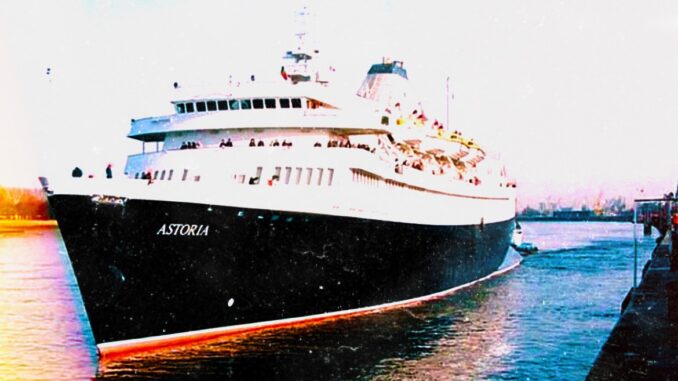
It’s been reported that MV Astoria—the former MS Stockholm originally launched in 1946—was sold at auction for €200,000 (just under $230,000) yesterday. This is according to the South Holland news outlet Rijnmond. The ship’s buyer remains anonymous for now, but it’s known they were the only bidder.
Whether the new owner will overhaul and refit the Astoria or break her up for scrap is still unknown. The ship’s ultimate fate still hangs in the balance.
The Gavel Falls
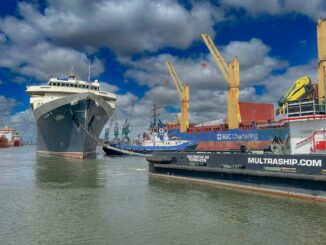
The Astoria arrived in Rotterdam in December 2020 after spending several months laid up in the UK. The ship has remained there ever since. A few weeks ago, the Rotterdam District Court ordered the sale of the Astoria to cover her dockage fees—said to be €700,000 (about $803,000) according to the AD.

The auction was overseen by the Dutch law firm Hoek Sinke Ten Katen, which outlines the judicial sale process on its website:
Under Dutch law, pledged goods can be sold judicially by public auction or by private sale, if allowed for by law and the contractual relationship at hand. We have extensive experience in organizing auctions and private sales.
As with the arrest of ships, Dutch auction proceedings are straightforward and pragmatically organised. Overriding principle is that the enforcing party must take head of the interests of all creditors and this is simply done by organizing the auction in such a way that a maximum price is reached. This objective is usually reached by applying the rules of the so-called Dutch auction. The bailiff is conducting the auction, the bidders are usually represented by their Dutch advocates who are doing the actual bidding. For the bystander it appears to be a rather nerve wrecking process and some costly mistakes have been made in the past. Stakes are literally high.
The system is as follows: first the high price is set. The bailiff calls out a certain amount, usual the minimum amount against which the vessel is to be sold. The advocates then engage in bidding over this amount, until an amount is reached that no one wants to overbid.
The highest bidder does not win the vessel yet, but he does win a premium of a certain percentage of the purchase price. This premium is for rewarding his bravery in setting the highest price. Let us imagine that the bailiff commenced bidding at US$ 9 mio, and that the highest bid is US$ 15 mio. All present know that a reasonable price for the vessel would be US$ 11 mio.
The second part of the auction commences. The bailiff is calling out an ever lower price: “US$ 15 mio, US$ 14.9 mio”, and so forth. The first bidder to shoot out “mine!” after the price has been called out has won the auction.
As there are two varieties on this type of auction, mistakes may be made. One variety adds the price as fixed in the first round to the price accepted in the second round. This means that in our example, the advocate shouting “mine” at US$ 10 mio has won the auction for a price of US$ 15 mio plus US$ 10 mio.
As the awarding of the vessel is mentioned in a court decision, usually available in writing on the same day, or the day after the auction, the registrars of ships worldwide are accepting this court decision as evidence that transfer has taken place. The bidder is under no obligation to disclose his principal to those present at the auction.
In short, the Dutch judicial sale process aims to maximize the sale price while balancing creditors’ interests. It starts with bidders proposing high prices, followed by a reverse bidding phase where the price decreases until a final winner emerges.
From Stockholm to Astoria
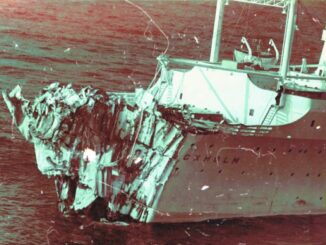
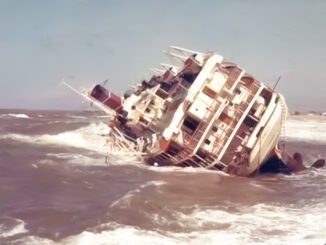
As the Swedish American liner MS Stockholm, Astoria played a critical role in one of maritime history’s most famous disasters, colliding with the Italian Line’s Andrea Doria on July 25, 1956. Her reinforced bow made the damage even more critical and sealed the Doria’s fate. The collision killed five aboard Stockholm and 46 on Andrea Doria.

East Germany purchased the ship in 1960 and renamed her Völkerfreundschaft. From there, she changed hands—and names—twice more before StarLauro Cruises (now MSC Cruises) acquired her in 1993. Rebuilt as a cruise ship in Genoa, Andrea Doria’s home port, the vessel earned the local nickname La nave della morte—“the ship of death.”

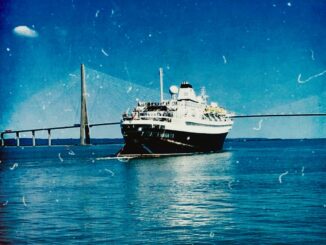
The ship first sailed as Italia I, then as Italia Prima, changing owners and names several more times until 2016. Cruise & Maritime Voyages acquired her and renamed her Astoria. The COVID-19 pandemic forced her into layup in the UK, where authorities eventually seized her following reports of Astoria leaving British waters without repatriating her still-stranded crew.
Uncertain Future, Enduring Legacy
Astoria’s new owner will need to settle the ship’s dockage fees before they can take full possession of the vessel. While hopes remain for an overhaul, such a project would be expensive. An urban explorer who sneaked aboard not long ago documented Astoria’s deteriorating interior on YouTube—and shipboard conditions have likely worsened since.

Realistically, scrapping appears the likeliest outcome. At 77 years old, Astoria has outlasted nearly all of her contemporaries. Few ocean liners or cruise ships enjoy such long careers—the average seems to be between 30-40 years. Whatever her final disposition, the former Stockholm occupies a unique place in maritime history, well beyond her tragic encounter with Andrea Doria all those years ago.
Leave a Reply