

When James Cameron’s Titanic hit theaters in December 1997, it wasn’t just a movie—it was an event. Audiences around the world fell for Leonardo DiCaprio, Kate Winslet, and their characters’ ill-fated romance aboard the doomed liner. A sweeping epic and technical marvel, Titanic won 11 Academy Awards and became one of the highest-grossing movies of all time. It became a cultural phenomenon.

But for the LGBTQ+ community, Titanic meant something more. It has endured as a queer cultural touchstone—one that continues to resonate over 25 years later. The question is, why? What about this grand, tragic, and heteronormative love story struck such a chord with LGBTQ+ audiences?
The answer lies at the intersection of identity, longing, and the desire to see oneself reflected in stories—even when that means reading between the lines.
Reading Between the Lines
LGBTQ+ audiences have long mastered the art of finding themselves in stories not explicitly written for them. It’s a form of creative survival—clinging to subtext, reinterpreting narratives, and identifying with characters whose struggles echo their own. That’s exactly what happened with Titanic at length.
The film’s themes of forbidden love, societal expectation, personal freedom, and self-empowerment resonated deeply. Jack and Rose’s star-crossed romance mirrored the experience of loving in secret and living under the weight of rigid social expectations. And when Rose ultimately chose to live on her own terms, it felt instantly familiar to queer viewers.
A “Coming Out” Narrative in Disguise
For many gay men, Titanic wasn’t just a love story; it was an emotional awakening. The intensity of Jack and Rose’s connection, their forbidden romance, and the undercurrent of inevitable tragedy struck a personal chord.

The film’s Edwardian setting—a time when LGBTQ+ lives were hidden and homosexuality criminalized—mirrored how queer people have historically been pushed to the margins. It really resonated with the community. The New Statesman observed how “in 1997, when LGBTQ+ protagonists in blockbuster films were a rarity, some of us had to look further to find versions of ourselves onscreen.”
Jack recognizes Rose’s true self and encourages her to break free from suffocating societal norms. This dynamic can easily be read as metaphorical. For queer viewers, especially teenagers or young adults, Jack represented unconditional love and emotional freedom.
Lesbians and Leomania
Leonardo DiCaprio was arguably the biggest heartthrob of the late 1990s. Leomania was inescapable. Audiences swooned over his portrayal of Jack Dawson — the sensitive, emotionally open artist who helps Rose discover her authentic self.

In her 2017 BuzzFeed article, Shannon Keating unpacked how DiCaprio became an unlikely lesbian icon. With his soft features, tousled hair, and boyish androgyny, Leo radiated an alternative to rigid masculinity.
For many lesbians—particularly those drawn to butch-presenting women—Jack Dawson wasn’t just desirable; he was relatable. The way he dressed, moved, and emoted felt intimately familiar. Some wanted to be with him, and others wanted to be him.
Camp, Melodrama, and Queer Catharsis
Queer culture has long embraced camp—a love of the exaggerated, the dramatic, and the over-the-top. It celebrates absurdity, excess, and heightened emotion with ironic affection. Films like Sunset Boulevard, Mildred Pierce, and Romeo + Juliet (another Leonardo DiCaprio movie) have become queer touchstones for these reasons, and Titanic fits comfortably within that tradition.
Its heightened emotions, lavish costumes, and tragic ending offered queer audiences catharsis: a space to feel seen, to mourn, to revel in rebellion, and to imagine a world beyond the one they were born into.

As writer Louis Staples noted in his article for The New Statesman:
Titanic is incredibly camp. From Maggie ‘new money’ Brown to Rose’s controlling mother, there’s no shortage of iconic characters with wide-brimmed hats and satin gloves. Even the way the ship crashes and disintegrates, complete with screaming, string music, and the gratuitous smashing of unused china, is gloriously camp.
And yet, Titanic managed to be both over-the-top and emotionally sincere—something few films have successfully balanced. As Alissa Wilkinson of Vox observed, that tonal duality is part of its enduring magic.
Longing and the Queer Experience
At its core, Titanic is a story about longing. Rose longs to escape the stifling world she’s trapped in. Jack longs for freedom, adventure, and meaningful connection in a society that offers him little security. Their intense, urgent, and ultimately doomed romance has long appealed to queer viewers, many of whom grew up seeing their loves and identities erased, criminalized, or ended in tragedy.

For queer audiences in the 1990s—when mainstream representation was scarce or coded—Titanic became an allegory for queer existence and yearning. Even earlier, in 1986, Jack Fritscher used the Titanic disaster as a metaphor for the AIDS epidemic, highlighting the ship’s narrative power as a symbol of lost lives and societal indifference.
The longing to be seen, to love openly, and to break free from rigid expectations is something LGBTQ+ audiences instinctively recognized in both Rose’s defiance and Jack’s outsider status.
Titanic’s Enduring Queer Appeal
Titanic became a cultural phenomenon for good reason. It’s a rich, beautifully crafted film that touches on universal themes like love, longing, and the yearning for personal freedom. That’s why LGBTQ+ audiences have embraced it, reading between the lines to see themselves in the story.
In recent years, there’s been a growing desire for LGBTQ+ representation within Titanic’s story, from fan fiction imagining Jack as Jacqueline Dawson, to novels about LGBTQ+ people aboard the real ship. Novels like Kindred Spirits: A Titanic Tale, A Million to One, and The Breath Between Waves reflect that ongoing desire.
But long before those works, there was Titanic—the 1997 blockbuster that smashed box office records and ultimately became a beloved queer-coded classic. Young and old LGBTQ+ viewers alike could find their desires, fears, and hopes reflected in James Cameron’s movie set on the most famous ship in the world.
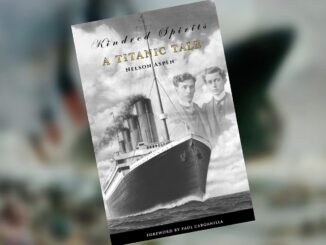

Thank you for the mention of “Kindred Spirits: A Titanic Tale.” Many of us lifelong Titanic enthusiasts (long before Jim Cameron ever made his first dive) have always known of her powerful draw to the LGBTQ+ community and find her ever-expanding appeal incredibly satisfying!