Here we are…the final Horror Movie Monday of 2024!
Today, we’re looking at a 1935 film called Phantom Ship (released as The Mystery of the Mary Celeste in the UK). Starring the great Bela Lugosi, this was one of Hammer Film Productions’ earliest offerings and puts a murderous, melodramatic spin on the real-life mystery of the Mary Celeste, a brigantine found deserted and adrift in December 1872.
How does this 89-year-old film hold up in 2024? Just how much dramatic overacting is there? Is it better than Death Ship? Let’s find out. Fair warning: spoilers and snark ahead.

Plot Summary
The film opens with Captain Benjamin Briggs (Arthur Margetson) and First Mate Toby Bilson (Edmund Willard) prepping the Mary Celeste for sea. They’re short on crew, and Captain Briggs insists on no shanghaiing and leaves for an appointment. Work on the Mary Celeste continues.
Meanwhile, Captain Briggs proposes to his sweetheart, Sarah (Shirley Grey), who’s torn between him and his best friend, Captain Jim Morehead (Clifford McLaglen). On cue, Morehead shows up. In a wonderfully overwrought scene, Sarah chooses Briggs. Morehead skulks away, saying he never wants to see either of them again.
Elsewhere, a one-armed man named Anton Lorenzen (Bela Lugosi) walks into a pub, barely recognized by the barkeep and patrons. Once a prizefighter known as “Handsome Anton,” Lorenzen was shanghaied six years earlier and has returned a shell of his former self.
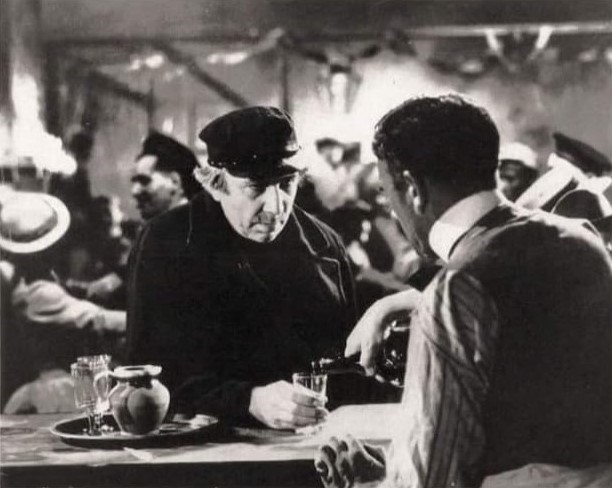
Still needing some crew, Captain Briggs eventually resorts to paying the bar owner $5 for every man he can press into service. Lorenzen signs on under the name “A. Gottlieb” after learning the ship is the Mary Celeste—a name that stirs fury within him. Still short on crew, Briggs approaches his ex-friend Morehead and asks for help. Still nursing his bruised ego, Morehead sends along a sailor named Grot (Herbert Cameron), secretly promising him a promotion if “something happens” to Briggs.
Somehow, apparently, Briggs and Sarah find time for a quick wedding, and she joins the voyage. One crewman leers at Sarah and swears she’ll be his wife before the journey’s over. Charming.
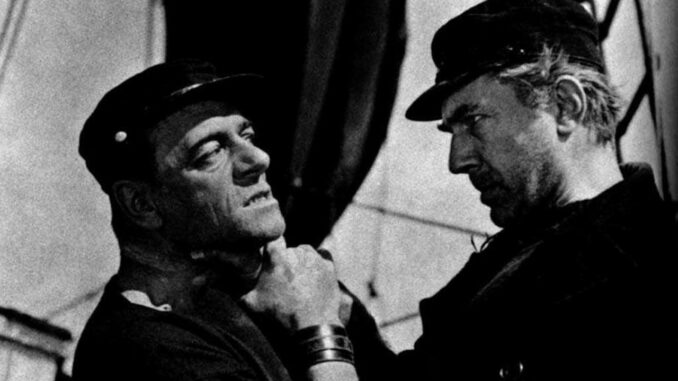
As the ship sets sail, it becomes clear that Bilson is a violent brute. Sarah watches him beat a man into submission, and while she’s horrified, Briggs dismisses it as standard discipline. Things escalate quickly when Grot, punished for insubordination, attempts to murder Briggs but is killed by the cook.
Meanwhile, Bilson goes into a fury upon discovering Lorenzen has brought a black cat aboard—a bad omen. When Bilson tries to throw it overboard, Lorenzen fights him off with surprising ferocity. He saves the cat, and Bilson’s called to the wheel.
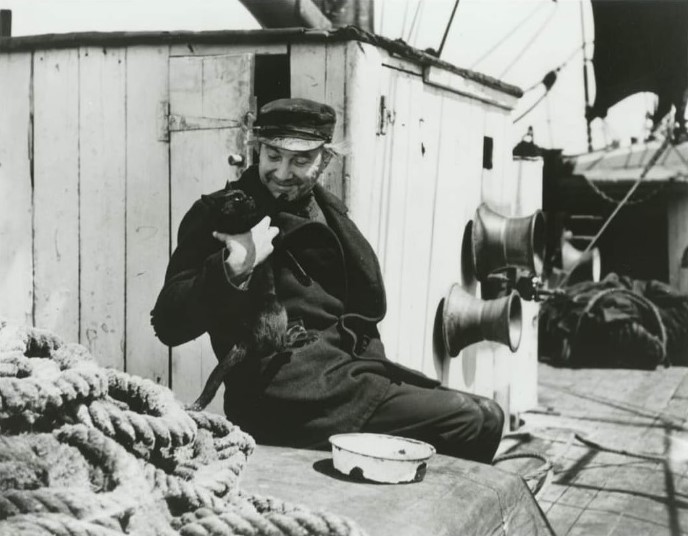
A storm hits the Mary Celeste, and chaos follows. Amid the madness, a crewman sneaks into the Briggs’ cabin and attacks Sarah. Lorenzen intervenes and kills the man, but is wracked with guilt over the deed. Another sailor dies in the storm—killed in an accidental fall.
From there, the crew starts dying off one by one. The helmsman is dead at the wheel, the ship drifting under his lifeless grip. Another in the galley. One more in the workshop, his gruesome state so horrifying that it drives a fellow sailor overboard. A potshot is fired at Captain Briggs and Sarah through their cabin window. Tension builds as paranoia spreads aboard the ship.
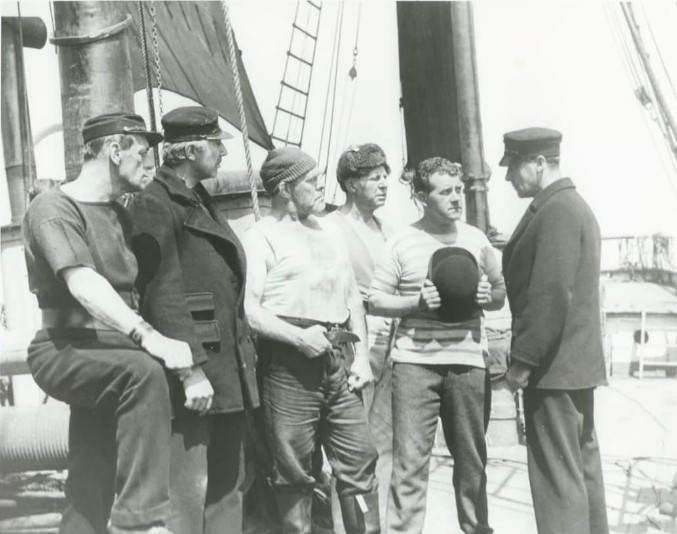
In a quiet moment, Lorenzen confides in Sarah about the horrors he endured: how a man tied him to a line, threw him overboard, and leading him to lose his arm to a shark. When he finally returned, he discovered his wife had vanished. Sarah listens, continually shocked by the cruelty men inflict on one another. It’s a surprisingly tender scene amid the bloodshed.
Eventually, only Bilson, Lorenzen, and Katz remain. Katz, convinced Bilson is the killer, attacks and is swiftly shot and dumped overboard. Bilson boasts about his plans to take the ship to the Azores and start a new life as “Captain Abercrombie.”
It’s then that Lorenzen makes his move. Revealing himself as the killer, he seizes Bilson’s revolver and delivers a chilling monologue about his hatred for the ship and the men aboard. Lugosi’s delivery is deliciously unhinged, his wild-eyed hatred practically radiating off the screen. In a wonderfully ridiculous moment, he shoots Bilson in the backside, then the kneecap, before tying him to a line and tossing him overboard to meet the same fate Lorenzen once suffered.
His vengeance complete, Lorenzen cackles madly as a shark closes in—but in his madness, he’s struck by the ship’s boom and knocked out cold. Regaining his senses, he realizes he’s alone. The black cat flees as he frantically searches for survivors on the Mary Celeste. In his madness and despair, Lorenzen throws himself overboard.
Some time later, the Mary Celeste is found adrift, abandoned—except for the black cat. In a final scene, Captain Morehead casually exchanges money with a sailor, smugly satisfied with the outcome. “I am thinking of Briggs and her,” he says, “dead!”
My Review
I have to admit—I really liked this one. It’s not a masterpiece, but it’s atmospheric, well-paced (after a slow start), and features Bela Lugosi doing what he does best: brooding, plotting, and delivering wonderfully unhinged monologues.
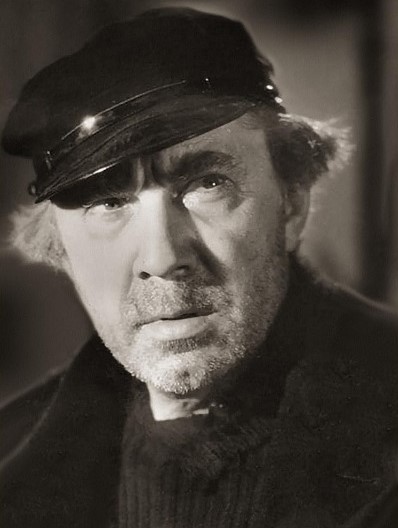
Unsurprisingly, Lugosi is the film’s standout. Grizzled, broken, and barely clinging to sanity, he commands every scene he’s in. The supporting cast fares reasonably well, though Captain and Mrs. Briggs are probably the weakest links. The Mary Celeste herself—portrayed by the real-life vessel Mary B. Mitchell, a former WWI Q-ship—provides a fantastic setting. The sailing sequences, with crewmen working the rigging, capture beautifully composed shots.
Phantom Ship may not be the most historically accurate film ever made, but it’s beautifully shot. The set design pulls you onto the sailing ship, which grows eerier as more crewmen meet their end.
Of course, it’s not without flaws. The love triangle subplot is clunky and unnecessary, though it was basically a requirement for 1930s cinema. There’s also a fair bit of theatrical overacting—particularly from Arthur Margetson as Captain Briggs, whose whiplash-inducing shifts between romantic sap and harsh disciplinarian feel unintentionally comic.
Interestingly, the British version of the film reportedly ran about 18 minutes longer and included courtroom scenes inspired by the real investigation into the Mary Celeste. Unfortunately, no known copies of that cut have survived.
Final Thoughts
In the end, Phantom Ship is a highly watchable, atmospheric piece of psychological horror. It’s dark, surprisingly creepy for its era, and anchored by Lugosi’s magnetic presence. Is it perfect? No. But it’s a solid little ghost ship mystery, and honestly — how can you go wrong with Bela Lugosi?
If you’re a fan of classic horror, maritime mysteries, or Bela Lugosi chewing scenery like it’s a four-course meal, this one’s definitely worth watching. It’s atmospheric, creepy, and wonderfully theatrical in all the right ways.
Have you seen the movie? If so, what did you think? Please let me know in the comments.
Leave a Reply