
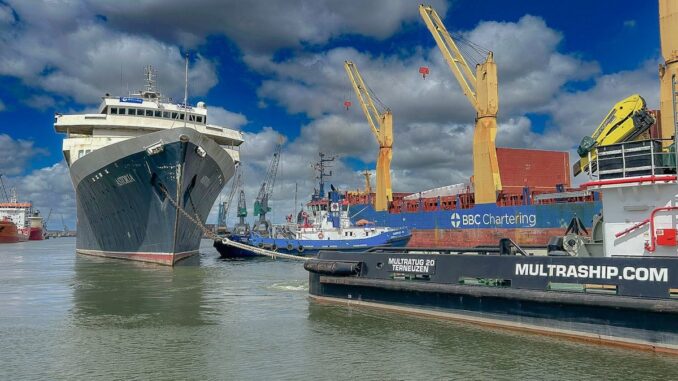
The infamous “Ship of Death” MV Astoria—the former MS Stockholm—has completed her final voyage. She arrived in Ghent, Belgium, at 6:30 pm for scrapping. It’s the end of a remarkable 77-year maritime career.
The Astoria departed Rotterdam under tow yesterday, July 3, after being laid up there for nearly five years. On June 17, the old liner was sold at auction for €200,000 (about $230,000), with Belgian recycling firm Galloo submitting the sole bid.

The European Union mandates that all EU-flagged vessels—Astoria is registered under Portugal’s Madeira International Shipping Register—must be scrapped in Europe.
A Legendary Ship
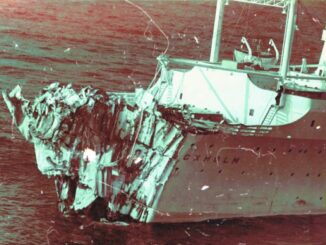
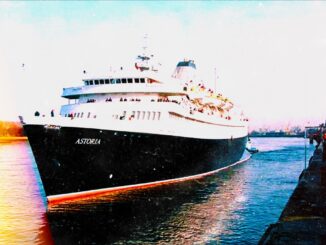
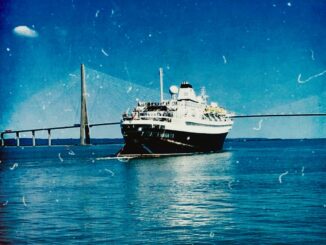
For those unfamiliar, Astoria has a long history. Launched in 1946 as MS Stockholm, she made headlines for her deadly collision with the Andrea Doria in July 1956. It was one of the most famous maritime disasters of the 20th century, as well as one of its greatest rescue operations. The Stockholm survived that incident and went on to sail under various names and owners for nearly eight decades, making her one of the last surviving ocean liners in the world.

With a legendary past like that, it’s definitely sad to see the old ship go to the breakers.
Galloo
Galloo is one of the largest ship recycling firms in Belgium, with over 75 years of experience dismantling vessels. According to the company’s website:
The company Galloo Ghent, part of the Galloo group, is located between the Noorddok and the Sifferdok in Gent-Zeehaven. The site of Galloo Ghent has an area of 8 ha. The canal at the 800-meter-long quay has been dredged to a depth of 12.5 meters. Galloo Gent plays an important role in the international scrap metal trade and exports 850,000 tons annually to…Turkey, Egypt and Asia.
Galloo will dismantle Astoria into her core materials, such as steel, other metals, glass, plastic, and wood. The company estimates it will recycle over 95% of the ship, yielding around 12,000 tons of salvage materials. By recovering and repurposing these resources, Galloo helps reduce waste and supports sustainable resource management in the maritime industry.
Sustainable Shipbreaking
This sustainability matters. The European Union has tightened environmental standards for shipbreaking in recent years. Improper dismantling—particularly in the notorious shipbreaking beaches of Chattogram, Alang-Sosiya, and Gadani—has created “toxic hotspots,” according to the NGO Shipbreaking Platform. These operations can release asbestos, oil, heavy metals, and other hazardous materials into surrounding waters, endangering marine life and nearby communities.
Older ships like Astoria pose particular risks due to the materials used during their construction. When the SS Norway (the former SS France) headed to Alang for dismantling, there was international outcry over the asbestos and other toxic materials aboard. Galloo’s Ghent facility dismantles ships under strict supervision, minimizing environmental impact and ensuring compliance with EU standards.
End of an Era
The Astoria has had a long and eventful life—I’ve covered her story in several posts by now. It’s undeniably sad to see her go, but it doesn’t diminish her legacy. Few ships sail for over seven decades—it’s a testament to her builders’ craft and sturdy construction.

And if a ship like Astoria must be broken up, it’s better to see it done by a company committed to environmental responsibility. It seems Galloo is the right company for the job.
With the Astoria’s dismantling now underway in Belgium, another chapter of maritime history quietly closes.
I travelled in ms Stockholm 1953 from Gothenburg to New York with my parents
Today I found the history of the ship and feel sad and happy in the same Time. It is possible to see it again? Or maybe the Time ran out?